




Research on Drug Quality under the International General Technical Requirements of Haibu Pharmaceutical
Classification:
Company News
Release time:
2020-12-16
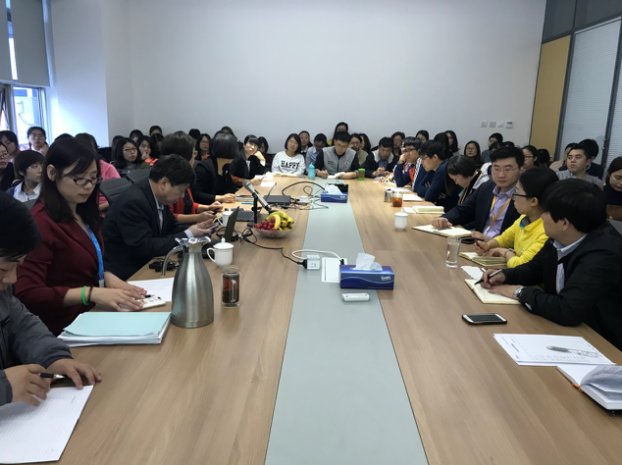
On April 13, 2018, Beijing Haibu Pharmaceutical Technology Co., Ltd. welcomed Dr. Tang Liya, founder and president of T3 PHARMA LINK from the United States, and Dr. Xiao Boming, general manager of Nanjing Baixian Pharmaceutical Technology Co., Ltd., who provided guidance and delivered wonderful academic reports on drug quality research topics such as "ICH regulations on drug quality and analytical methods" and "the starting point, endpoint, and cycle management of analytical methods."
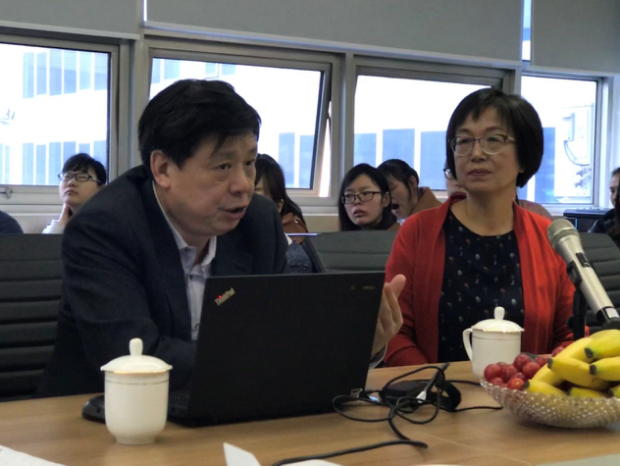
Our company adheres to the enterprise policy of 'technology as the core, talent as the foundation', continuously strengthening the research capabilities of R&D personnel in the field of pharmaceutical research. This academic report has injected advanced R&D ideas into our chemical drug development work and perfectly combined theory and practice in drug development through case analysis of company projects.
During this training session, Dr. Tang provided guidance on ICH regulations regarding drug quality: specifically addressing the norms and rationality of analytical methods at different stages of development; in addition to pharmacopoeia standards and CFDA-released guidelines for drug development, she discussed control methods and requirements for various impurities such as genotoxic impurities, isomers/chirality, and residual solvents. Regarding the starting point, endpoint, and cycle management of analytical methods: including that the quality of analytical methods originates from design, method objectives, risk assessment; validation, confirmation, and transfer of analytical methods. After this systematic explanation training session, I believe that colleagues will have a clearer understanding during the process of developing analytical methods.
Dr. Tang provided detailed explanations on ICH Q8, Q9, Q10 regarding drug development; previously focusing on data transmission and variable output quantities but now emphasizing knowledge transfer and scientifically consistent output quantities; quality risk management was previously undefined and unstructured but is now using structured processes; Q10 pharmaceutical quality system reminds us that in the future we should establish a quality system throughout the product lifecycle while maintaining consistency across the entire lifecycle quality system; Q12 guides companies to add procedures for handling situations beyond specified limits to reduce complexity after market changes which provides new ideas for our R&D work.
Regarding genotoxic impurities, ICH M7 has detailed classifications for genotoxic impurities which can be broadly categorized into several types:
| Impurity Class Impurity Category |
Definition Definition |
Guidance for control Control Guidance |
| Class 1 |
Known mutagenic carcinogens Known mutagenic carcinogens |
Control at or below compound-specific acceptable limit Control at or below compound-specific acceptable limit |
| Class 2 |
(bacterial mutagenicity positive*, no rodent carcinogenicity data) (known mutagens with unknown carcinogenic potential (bacterial mutagenicity positive*, no rodent carcinogenicity data)) |
(appropriate TTC) (control at acceptable limits (appropriate TTC)) |
| Class 3 |
Alerting structure, unrelated to the structure of the drug substance; no mutagenicity data 警示结构,与原料药结构无关;无致突变性数据 |
If non-mutagenic = Class 5 如无致突变性,归为5类 If mutagenic = Class 2 如有致突变性,归为2类 |
| Class 4 |
Alerting structure, same alert in drug substance or compounds related to the drug substance 警示结构,与原料药结构有关;无致突变性数据 |
Q3A Q3B
|
| Class 5 |
No structural alerts, or alerting structure with sufficient data to demonstrate lack of mutagenicity or carcinogenicity 无警示结构 |
基因毒性杂质分析中使用的分析技术,归类起来有以下几种:
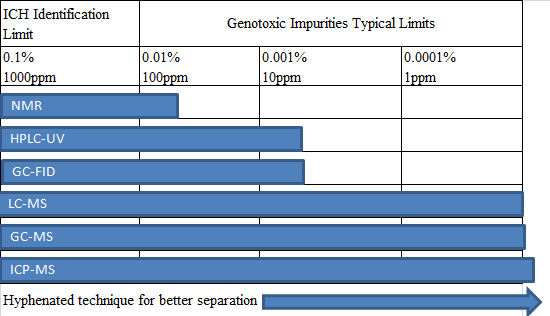
对于大多数药物的基因毒性杂质,可以用LC-MS及GC-MS来进行检测,各种分析技术方法的使用百分比见下表:
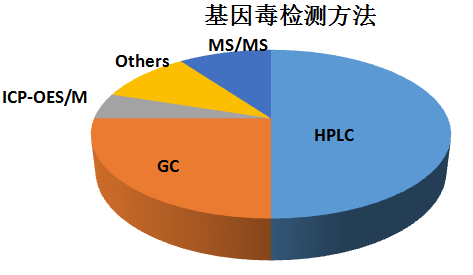
对于分析方法的质量源于设计,汤博士更是有一套自己有效的DOE方法,可以使用“鱼骨图”或表格形式,分别分析各参数的风险因子,根据风险级别的大小,确定分析方法设计空间。
| Risk for Low or High Assay/Impurity Results(含量/有关物质风险评估表) | |||||
| Risk Factor (Failure mode) | Severity high=3 medium=2 low=1 |
Probability high=3 medium=2 low=1 |
Detectability high=1 medium=2 low=3 |
Numerical Rating S×P×D |
CQA |
| Environment | |||||
| Room Temperature | 1 | 1 | 1 | 1 | |
| Room Humidity(regular samples) | 1 | 2 | 1 | 2 | |
| Room Humidity(hydroscopic samples) | 3 | 2 | 1 | 6 | Y |
| Material | |||||
| sample | |||||
| Solvent (more risk on impurity) | 2 | 2 | 2 | 8 | Y |
| Water (more risk on impurity) | 2 | 2 | 2 | 8 | Y |
| Analyst | |||||
| Weighting | 3 | 2 | 2 | 12 | Y |
| Mixing | 3 | 2 | 2 | 12 | Y |
| Transferring | 3 | 2 | 2 | 12 | Y |
| Glassware | |||||
| Volumetric flask & Pipette | 3 | 2 | 1 | 6 | Y |
| Autosampler Vial (more risk on impurity) | 3 | 1 | 2 | 6 | Y |
| Bottle & Baker | 1 | 1 | 2 | 2 | |
The red color represents high risk, yellow represents medium risk, and green represents low risk.
Based on the results of the risk assessment and validation, determine the plan for method transfer validation to make it more scientific and reasonable.
Dr. Xiaoboming provided deeper insights and supplements during the lecture, reinforcing understanding through examples from the project, allowing colleagues to gain a deeper understanding of chemical drug development work.
The lecture lasted about 9 hours. Through this training, colleagues at Haibu Pharmaceutical greatly benefited. The advanced R&D ideas brought by the teachers broadened everyone's research and development perspective. The two teachers also expressed their recognition of everyone's learning attitude and enthusiasm, believing that in future drug development work, they can apply what they have learned to contribute to the company's vigorous and stable development.

Beijing Hope Pharmaceutical Co., Ltd.