




Haibu Medicine, 2018 First Academic Exchange Salon Event
Classification:
Haibu Growth Camp
Release time:
2018-07-05
In order to further strengthen the technical communication and ideological collision among the company's R&D personnel, the Haibu Pharmaceutical Academic Committee will hold a monthly academic exchange salon activity starting from January 2018. Each session will focus on a specific academic theme for sharing and discussion, learning and exploring new technologies and dynamics in the fields of drug research and development and production both domestically and internationally, summarizing and sharing valuable experiences accumulated in daily R&D work, thereby inspiring everyone to continuously learn, think actively, and bravely break through. This will serve as a link and bridge for internal information transmission, knowledge accumulation, and technology application within the company.
On the afternoon of January 12, 2018, Haibu Pharmaceutical held its first academic exchange salon of the year. Participants in this salon came from core R&D technical personnel across various departments and specialties within the company.
Director Li Peng, chairman of this academic committee, organized and hosted this event throughout. Before the start of this salon, Director Li Peng led relevant committee members to reiterate the purpose and program of the company's academic committee and unified opinions on the revision of the 'Haibu Pharmaceutical Academic Committee Charter.'
Dr. Huang Xiaogen, Technical Director of Haibu Pharmaceutical's Innovation and Cooperation Center, served as the keynote speaker for this academic salon. The theme he shared with everyone was 'Efficiency Comes from Design - Process Optimization and DoE (Design of Experiments).' He compared single-factor research (OFAT) with DoE from an overall perspective of pharmaceutical R&D regarding their differences and advantages/disadvantages. He also provided detailed explanations on several aspects such as the purpose of DoE, commonly used methods, application stages, how to implement it effectively along with a case study that breaks down each step of DoE. At the end of his presentation, he left a topic for discussion: OFAT or DoE?
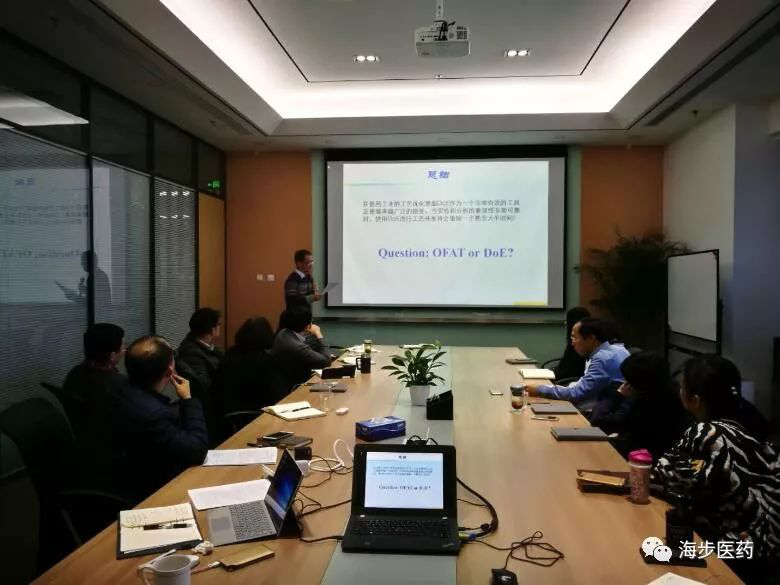
Subsequently, professionals present actively spoke up; the focus of discussion was on which is superior in their respective fields: single-factor research or statistically-based DoE. Everyone expressed their views on various aspects such as the necessity of scientific design, feasibility of applying various R&D equipment or software tools under real conditions at the company to improve R&D efficiency while reducing costs as well as difficulties in implementation and solutions.
Everyone generally agreed with Professor Guo's viewpoint: DoE is a way of thinking. The proposition 'Efficiency Comes from Design' itself tells us that overall efficiency is based on design; only after scientifically designing a plan can we control our desired results within specified quality requirements through response analysis across multiple factor parameter ranges. DoE is not a magic bullet but rather a set of meticulous technical means; it is an essential scientific practice step that can help us achieve three things: (1) identify major significant factors; (2) find optimal condition combinations; (3) prove that optimal condition combinations are reproducible. Participants unanimously believed that our work in drug research itself is a complex multi-factor research process that can pragmatically apply DoE at different stages based on real conditions at our company and technical capabilities among professionals.
Haibu Pharmaceutical is an R&D technology-based enterprise that constantly faces challenges brought by emerging new technologies, new ideas, new processes, and new methods. How to transform Haibu into a learning organization is currently a major topic; every team member must have problem identification and solving abilities so that enterprises can continuously attempt innovations to improve their adaptability to environmental changes while enhancing core competitiveness: scientifically rigorous with lean R&D; innovatively seeking change with efficient transformation!
Medicine, research, female deer, one, share, design, academic, conduct, we
Next Page
Next Page

Beijing Hope Pharmaceutical Co., Ltd.